Operating method
Facility identity governance
A controlled register and correction workflow for keeping names, addresses, phones, hours, URLs, public profiles, and lifecycle states aligned.
Read the operating noteResearch and methods
This public research surface explains how operating questions become supportable publications. Methods, frameworks, and proposed standards are available now. Company-specific performance findings remain unpublished until source, privacy, reconciliation, review, and permission gates are complete.
Current public work
Operating method
A controlled register and correction workflow for keeping names, addresses, phones, hours, URLs, public profiles, and lifecycle states aligned.
Read the operating noteDecision method
A boundary for separating source facts, model suggestions, approvals, actions, and reconciled outcomes in AI-assisted work.
Read the frameworkResearch method
A reproducible release path that names the question, source, period, numerator, denominator, intervention, exceptions, reconciliation, privacy, and limitations.
Open the case-study methodProposed standard
Six tests for source-grounded, context-mapped, authority-aware, measurable, reviewable, and recoverable AI-assisted operating systems.
Review the proposed standardExpert technical paper
An eight-stage trace model for preserving context, recommendation, authority, human adjudication, provider acceptance, governing-source readback, reconciliation, and closure.
Open the trace modelExpert reference architecture
A governed event-driven pattern that keeps observations, commands, policy decisions, projections, and reconciliation evidence distinct across a self-storage portfolio.
Open the event-spine architectureAdvanced operating method
A consequence-aware method for measuring whether automated operating work is fresh, complete, reconciled, recoverable, and supported by trustworthy evidence.
Open the automation SLO methodExpert architecture paper
A consequence-routed, evidence-complete, capacity-bounded queue for qualified adjudication, visible aging, execution, reconciliation, and reopening.
Open the human-review queue architectureOperator reporting control
A source, period, population, unit, formula, correction, reconciliation, and claim-boundary control for self-storage and AI reporting.
Open the reporting controlAdvanced research governance
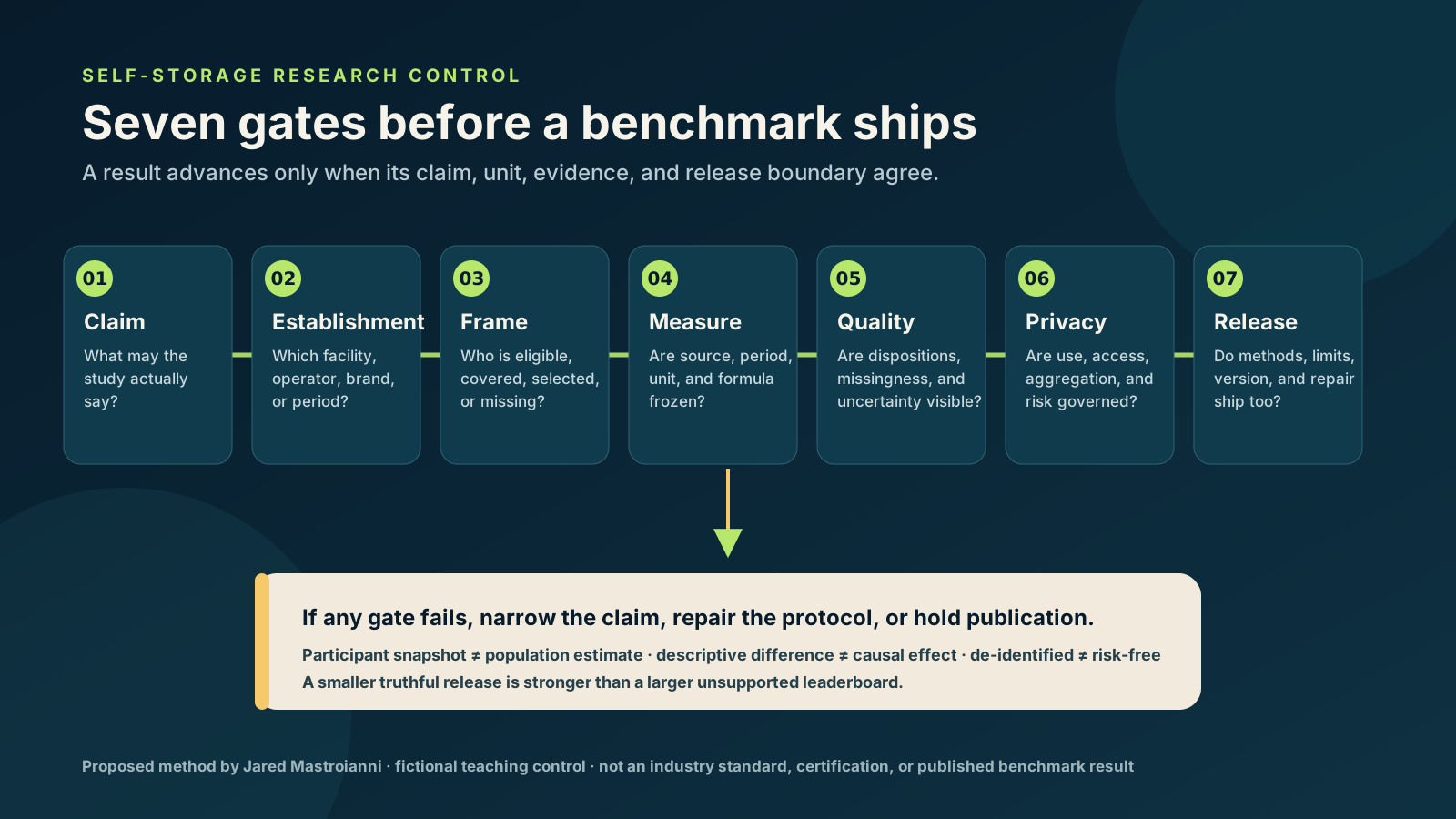
A reproducible benchmark method for declaring the claim, establishment, frame, sample, measures, dispositions, uncertainty, privacy, AI use, and release gates.
Open the benchmark protocolEvidence state
No company-specific result is cleared on this page. A planned or discussed study is not an executed study; an executed analysis is not reconciled; and a reconciled result is not public until the responsible source owner and reviewer approve its release.
Owned research can document a method or a measured result. It does not become independent coverage, market leadership, customer proof, certification, or evidence of encyclopedic notability.
Publication ladder
Publishes a process, definitions, and limits. It does not report a company result.
Documents a defined population or period without making a causal claim.
Uses a declared comparison, consistent definitions, and an auditable denominator.
Adds an intervention, reconciliation proof, privacy review, limitations, and publication permission.
Requires an editorially and analytically independent party; owned work cannot self-assign this label.
Reusable tools
These tools define a method. They contain no company-specific customer, revenue, occupancy, performance, legal-ownership, or product-availability result.