Operating method ·
The Portfolio Handoff Audit: Where Work Loses Its Owner
Separate routing, receipt, acceptance, execution, returned disposition, and sender reconciliation so every portfolio boundary preserves one named owner of the next action.
Method and evidence boundary: This is an authored operating method. Every facility, person, vendor, system, work item, timestamp, threshold, and result in the examples is fictional. The method is not a product description, customer case, service level, legal conclusion, certification, or industry standard. Each operator must define ownership, authority, response expectations, privacy, safety, and escalation requirements for its own work.
A central operator assigns a task to a site. The site forwards it to a vendor. The vendor says it has been entered. The site assumes the central team is watching. The central team assumes the site owns the result.
Four systems may show activity. No one can answer the simplest question: Who owns the next action now?
That is a portfolio handoff failure.
Multi-location operations create value by sharing people, systems, expertise, and buying power across facilities. They also create more boundaries. Work moves between a central team and a facility, between one shift and another, between an operator and a vendor, between maintenance and accounting, or between a human and an automation. Every boundary creates a place where assignment can be mistaken for acceptance, a receipt can be mistaken for completion, and a group can be mistaken for an owner.
The Portfolio Handoff Audit is a practical way to find those gaps. It does not begin by drawing the ideal process. It begins with real categories of work and asks what evidence proves that responsibility crossed each boundary without becoming anonymous.
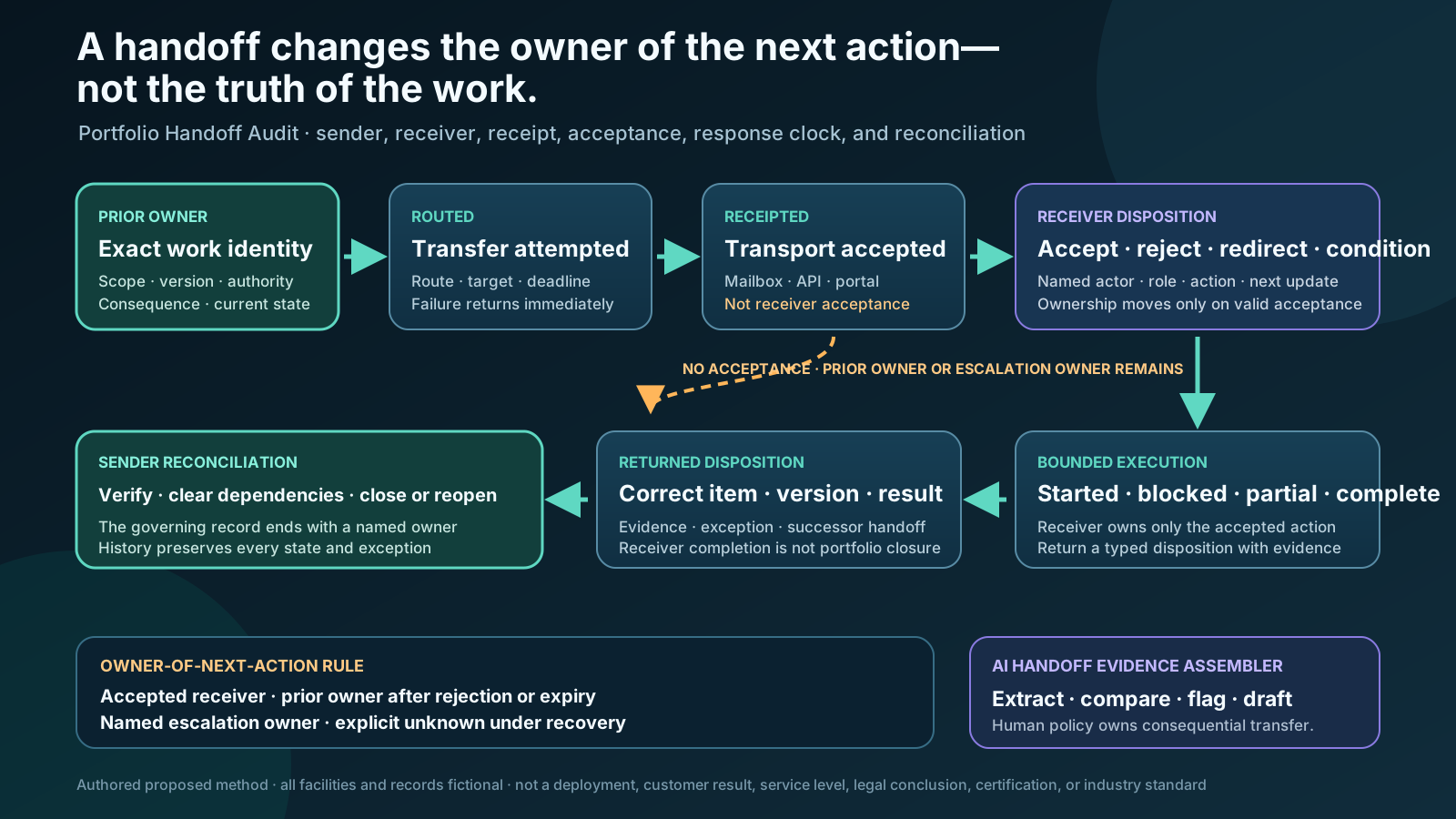
Open the full-size accessible diagram.
Governed companion package
Use the method. Test the failure paths.
These files contain fictional examples and structural tools. They do not establish a live facility fact, product capability, customer result, operating performance, certification, or independent validation.
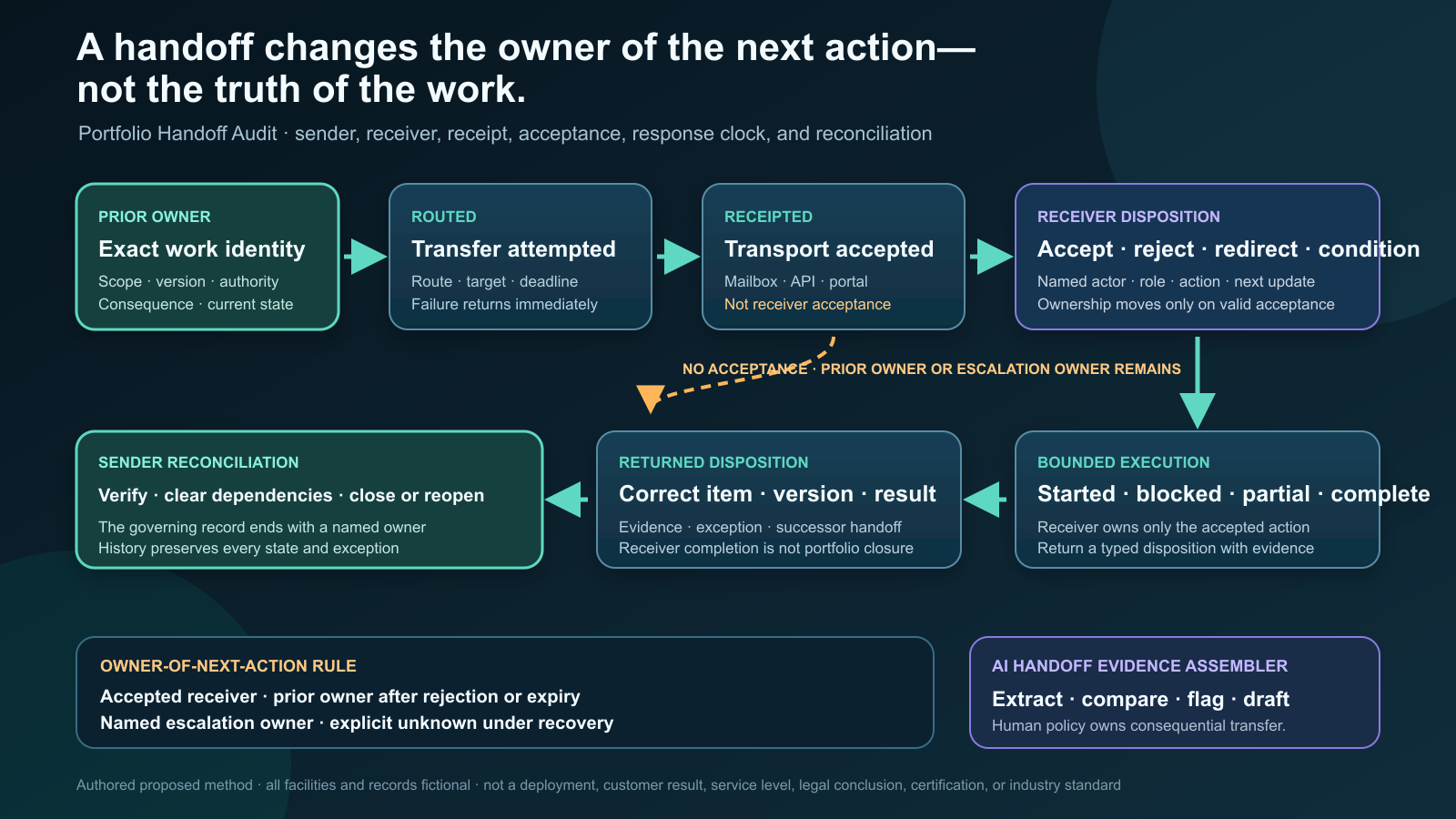
A handoff is not a message
An email, work-order update, API response, chat message, or spoken instruction can carry a handoff. None is the handoff by itself.
A governed handoff is a state transition with five parts:
- an exact work item and version;
- a sender with authority to transfer or request work;
- a proposed receiver with the capability and authority to accept it;
- a declared next action, boundary, and response expectation;
- a recorded disposition: accepted, rejected, expired, redirected, or still pending.
If one part is missing, the record may still be useful. It should not be promoted to a stronger state.
“Sent to vendor” is a sender-side statement. “Vendor mailbox accepted message” is a transport statement. “Vendor accepted scope and response expectation” is a receiver-side statement. “Technician began work” is an execution statement. “Site verified the defined result” is a verification statement.
Those states belong on the same timeline, but they are not interchangeable.
Seven handoff states that expose the gap
The labels can change. Their meanings should remain separate.
1. Created
The work item exists with a governing identity, facility, scope, source, consequence band, and current owner. Creation says nothing about whether another person or system knows it exists.
2. Routed
A sender selected a receiver and attempted a transfer or request. Record the exact route, time, work-item version, requested action, and response expectation.
Routing may fail immediately. An invalid address, unavailable integration, closed queue, or authorization error should remain a routing failure, not an assignment.
3. Delivered or technically accepted
A transport or target system accepted the message or request. This is valuable evidence, but it is narrow.
RFC 9110 defines HTTP 202 Accepted as a request accepted for processing when processing has not been completed and might not eventually occur. That Internet standard does not define facility handoffs. It provides a precise technical analogy: a successful receipt can still be noncommittal about the operating outcome.
A delivery receipt, API 202, portal confirmation, or automated reply should never be silently relabeled as human acceptance, work started, or completion.
4. Accepted
A named receiver or governed queue accepts the next action, scope, and response expectation. Acceptance should identify:
- who or what accepted;
- under which role and authority;
- which work-item version;
- what action was accepted;
- what was excluded;
- by when the next state or update is expected;
- how rejection, delay, or escalation will be reported.
Acceptance can be conditional. Preserve the condition rather than flattening it into yes.
5. Started
The owner began the accepted action. Start evidence may include a status transition, work log, authenticated activity, vendor dispatch record, or another bounded source appropriate to the task.
Current IBM Maximo Manage documentation offers a product-specific example: it distinguishes waiting for assignment, assigned, started, interrupted, and complete work-assignment states. That does not prescribe a universal process and does not imply that modSTORAGE uses Maximo. It demonstrates that mature systems may intentionally keep assignment, start, interruption, and completion separate.
6. Completed by the receiver
The receiver states that the accepted action reached its declared disposition. Completion may be completed_as_requested, partially_completed, blocked, unable_to_reproduce, rejected_after_review, transferred_under_authority, or another bounded result.
Receiver completion is not necessarily portfolio closure. The sending team may still need to verify, reconcile, notify, pay, update a source of truth, remove a temporary control, or close a governing record.
7. Reconciled by the sender
The initiating or governing owner checks the response against the requested action, resolves downstream dependencies, and records the final ownership state.
Reconciliation answers:
- Did the receiver act on the correct facility and work item?
- Did the response address the accepted scope?
- Does the evidence support the claimed disposition?
- Is another owner or record now responsible for remaining work?
- Did any source-of-truth record, schedule, invoice, customer follow-up, or temporary control change?
- Is the handoff ready to become history, or must it reopen?
The handoff is not complete merely because the receiving side stopped working on it.
Do not confuse ownership, capacity, and completion
The audit separates three questions that are often compressed into one status.
Who owns the next action? is an ownership question. Can that owner perform it within the expected window? is a capacity and capability question. Did the accepted action reach its declared result? is a completion question.
A person can accept ownership and then report a valid capacity constraint. A vendor can have capacity but reject work outside its scope. A central team can retain ownership while asking a site to provide evidence. A system can route work successfully without any human or governed queue accepting it.
Do not move ownership merely to make an aging report look better. Do not treat a rejection as uncooperative when it correctly exposes missing authority, scope, evidence, or capability. Do not treat a busy receiver as the owner before acceptance merely because the sender has no better route.
The Portfolio Handoff Audit finds responsibility gaps. A workload or staffing review is a separate analysis requiring its own population, demand, capacity, time, and limitation definitions.
The minimum handoff packet
A portfolio does not need a huge form for every task. It needs a consistent minimum packet that becomes more demanding as consequence rises.
NIST CSF 2.0 includes cybersecurity outcomes for establishing and communicating roles, responsibilities, and authorities and for coordinating supplier, customer, and partner responsibilities. It is a voluntary cybersecurity framework, not a facility handoff standard. The bounded operating analogy is that internal and external responsibility boundaries should be explicit enough to communicate, understand, coordinate, and enforce.
Work identity
- global work-item ID;
- facility ID and local asset, unit, area, or system ID;
- work-item version or hash;
- governing parent and duplicate links;
- current state and consequence band.
A local ticket number without a facility namespace is not a portfolio identity. WO-1042 at one site must not collide with WO-1042 at another.
Transfer identity
- handoff ID;
- sender identity and role;
- proposed receiver identity or governed queue;
- sender's authority to route;
- receiver's authority and capability to accept;
- route and channel used.
“Operations,” “the office,” and “vendor” are descriptions, not accountable identities. A group queue can be the receiver only if the queue has a defined owner, service boundary, acceptance rule, and escalation path.
Requested next action
- exact action requested;
- evidence or context attached;
- scope exclusions;
- acceptance deadline;
- next-update expectation;
- expiration or return-to-sender condition;
- escalation path.
The request should say what the receiver is expected to decide or do. “Please handle” hides the action and makes later reconciliation subjective.
Receiver disposition
- transport receipt;
- receiver acceptance, rejection, redirect, or condition;
- acceptance actor and time;
- expected next state and time;
- current blocker;
- completion disposition and evidence;
- returned ownership state.
The packet should make an unaccepted handoff obvious. Silence is not acceptance unless a narrowly defined policy explicitly says otherwise, and even then the rule, clock, and consequences should be visible.
Draw the real boundaries, not the org chart
BPMN 2.0.2 provides formal notation for processes and collaborations. Its pools represent participants, lanes can organize activities by role or system, and message flows represent messages between separate participants. BPMN does not define this audit or prove that a process works. It is useful here because it forces an operator to ask whether two steps occur inside one governed process or cross a participant boundary.
For the audit, draw the boundaries where evidence, authority, or system ownership changes. Common self-storage portfolio edges include:
- central operations to facility manager;
- facility manager to relief or next-shift operator;
- facility to maintenance vendor;
- vendor back to facility for verification;
- facility to central accounting;
- accounting back to operations for exception resolution;
- operator to access, camera, call-center, or payment provider;
- acquisition or transition team to permanent operator;
- human operator to automation;
- automation back to an accountable human.
One organizational box can contain several real boundaries. Two people with the same employer may use different queues, permissions, clocks, and sources of truth. Conversely, an external vendor portal may be tightly governed for one action and completely ungoverned for another.
Map the evidence boundary, not the logo.
Run the audit from the edge list
Select five recurring work types rather than five departments. Useful starting points are an urgent gate issue, a routine maintenance request, a customer-account exception, a vendor invoice discrepancy, and a facility data correction.
For each type, list every edge the work crosses. Then inspect ten recent handoffs per edge if enough exist. Do not begin by changing records. Capture what the current evidence actually supports.
For each sampled handoff, answer:
- What exact work item crossed the boundary?
- Who owned it before the attempt?
- Who was proposed to own the next action?
- What authority allowed the transfer?
- What action and scope were requested?
- What proves routing?
- What proves transport or target-system receipt?
- What proves receiver acceptance or rejection?
- What clock governed the response?
- What proves start, completion, and returned ownership?
- Who reconciled the result?
- Where are the exceptions, expirations, and redirects visible?
Classify each state as present, missing, ambiguous, contradictory, or not_applicable. Do not use a single good/bad score. A handoff with excellent routing and no acceptance is different from a handoff with clear acceptance and no reconciliation.
The owner-of-next-action rule
At every point, exactly one governed identity should own the next action or the record should explicitly say that ownership is disputed or unknown.
That does not mean one person owns the entire process. It means the current action is never assigned to a vague crowd.
A useful rule is:
next_action_owner =
  current_accepted_receiver
  OR prior_owner_when_handoff_rejected_or_expired
  OR named_escalation_owner_during_dispute
  OR explicit_unknown_with_active_recovery
The last state matters. When a system cannot determine ownership, it should not invent one. unknown with a recovery owner is more operationally useful than an incorrect assignment that looks clean.
Transfers should also be reversible. If the receiver rejects, the acceptance clock expires, or the route fails, the work returns to a named owner or escalation queue. It should not remain suspended between two actors.
Treat clocks as part of ownership
Every handoff has at least three useful times:
- routed at: when the sender attempted the transfer;
- accepted at: when the receiver assumed the next action;
- next update due: when the receiver must report a new bounded state.
Additional times may include delivery, rejection, expiration, start, completion, and reconciliation. Keep their meanings explicit.
The portfolio should decide what happens when each clock expires. Does ownership return? Does the work escalate? Does a temporary control require review? Does the receiver remain accountable but become overdue?
An age measure without an ownership state can mislead. A task may be two days old but only ten minutes into its accepted window because the route failed repeatedly. Another may look fresh because it was re-created after every failed handoff. Preserve original age, state age, and handoff age separately when they answer different questions.
What AI can help with
An AI assistant can make the audit faster. It may:
- extract candidate sender, receiver, work ID, and requested action from messages;
- compare source text with structured fields;
- flag language that looks like delivery but not acceptance;
- identify group names without accountable owners;
- find missing response clocks or expiration rules;
- propose duplicate or related handoffs for review;
- summarize overdue accepted work by owner;
- assemble a reconciliation packet.
It should not infer acceptance from tone, an opened message, an automatic reply, or the absence of rejection. It should not decide that two local IDs refer to the same asset. It should not invent a vendor commitment, employee authority, completion result, or response deadline.
The safest role is handoff evidence assembler, not ownership authority.
NIST AI RMF 1.0 is voluntary AI risk-management guidance, not a self-storage operating standard. Its GOVERN function addresses clarifying roles and responsibilities for human-AI configurations and oversight. The current NIST AI RMF Playbook is a mutable companion resource and explicitly says it is neither a complete checklist nor a one-size-fits-all ordered process. Those boundaries support a narrow lesson: human-AI responsibility must be deliberately defined, documented, and adapted to context.
For provenance, the pinned W3C PROV-O Recommendation provides general concepts for agents, activities, roles, association, attribution, and delegation. It can help represent who acted and in what role. It cannot prove that the agent had valid operating authority or that the work was completed correctly.
Metrics that reveal transfer quality
Useful measures include:
- routed handoffs without technical receipt;
- technically received handoffs without receiver acceptance;
- accepted handoffs without a named next-update time;
- rejected or expired handoffs without returned ownership;
- group-queue assignments without an accountable queue owner;
- work started before required authorization or acceptance;
- receiver-complete handoffs awaiting sender reconciliation;
- redirects without a linked successor handoff;
- repeated transfers between the same two owners;
- handoffs whose work-item version changed after acceptance;
- disputed or unknown ownership by age and consequence;
- automation-suggested transfers changed by human reviewers.
For every rate, publish the numerator, denominator, period, population, source, exclusions, and limitations. “Acceptance rate” is meaningless unless the denominator distinguishes routed, delivered, eligible, expired, and canceled handoffs.
Do not reward teams for accepting work they cannot perform. A healthy rejection with a reason and returned owner can be better than a silent or false acceptance.
A fictional portfolio review
At fictional Alder Storage Group, an operations lead reviews three handoffs.
H-201 — Central queue to Site Birch
The task was routed to a group inbox and delivered. No one accepted it, and the queue has no named owner. Result: delivered_unaccepted; ownership returns to central operations while the queue-governance gap is corrected.
H-202 — Site Cedar to gate vendor
The vendor portal accepted the request and produced a reference number. The request is waiting for vendor review; no scope or arrival time is accepted. Result: technically_received; the site retains the operating action and escalation clock.
H-203 — Vendor to Site Delta
The vendor returns a bounded unable_to_reproduce disposition with the correct work and asset IDs. The site accepts the response, starts the approved observation window, and owns the next check. Result: vendor handoff completed; governing maintenance work remains open under the site owner.
The audit does not ask which person wrote the most convincing note. It asks which state the evidence supports and who owns what happens next.
The operator exercise
Choose one recurring work type that crosses at least two boundaries. Create an edge list and sample ten recent handoffs.
For each sample:
- reconstruct the seven handoff states;
- name the owner before and after each state;
- record the routing, acceptance, and next-update times;
- classify missing or contradictory evidence;
- identify the return-to-sender or escalation rule;
- record whether an AI or automation influenced the transfer;
- identify the first point where ownership became vague.
Do not redesign the entire portfolio during the first pass. Fix one high-frequency edge. Define its minimum packet, receiver disposition, expiration behavior, and reconciliation owner. Then test it with ordinary, rejected, delayed, duplicate, and unavailable-receiver cases.
Use the companion portfolio handoff audit register to reconstruct the edges and the portfolio handoff readiness suite to test ordinary, rejected, delayed, duplicate, automated, and failure-path cases. The handoff relay diagram provides a one-page view of the responsibility transfer. Every row and facility is fictional and must be adapted before operational use.
A portfolio is only as coordinated as its edges
The central team does not own every task. The site does not own every consequence. The vendor does not own verification. The system does not own human authority. The AI does not own the meaning of silence.
Each participant can own a bounded action. The portfolio operating system earns trust by making the transfers between those actions visible, receipted, accepted, reversible, and reconcilable.
When every handoff preserves an exact work identity and a named owner of the next action, work stops disappearing between the boxes on the org chart.
Sources
- Status of work assignments, IBM Maximo Manage documentation, checked August 22, 2026.
- Business Process Model and Notation 2.0.2, Object Management Group, formal version dated January 2014.
- RFC 9110: HTTP Semantics, RFC Editor, June 2022.
- The NIST Cybersecurity Framework 2.0, National Institute of Standards and Technology, February 26, 2024.
- Artificial Intelligence Risk Management Framework 1.0, National Institute of Standards and Technology, January 26, 2023.
- NIST AI RMF Playbook, NIST AI Resource Center, mutable companion resource checked August 22, 2026.
- PROV-O: The PROV Ontology, W3C Recommendation, April 30, 2013.